

Screaming Architecture: A Feature-First Approach for Modern Applications
TABLE OF CONTENTS
- The Business Cost of Poor Code Organization
- A Feature-First Way to Structure Your Application
- Why This Matters for Growing Engineering Teams
- How Triveni Applies This in Client Projects
- Looking Ahead
- Conclusion
-
Frequently Asked Questions (FAQs)
- What is Screaming Architecture?
- Why is it called Screaming Architecture?
- What is feature-first architecture?
- What are the main folders in Screaming Architecture?
- What should go inside a feature folder?
- Is Screaming Architecture useful for small applications?
- Does Screaming Architecture improve application performance?
- Can Screaming Architecture be used with different technologies?
- Can Screaming Architecture work with micro-frontends?
- What is the main benefit of screaming architecture?
- Stay ahead of the curve
Share on Social Media
Related Blogs

How to Responsive sticky Header, Footer In Html Table?
Read More: How to Responsive sticky Header, Footer In Html Table?
What are Promises in JavaScript?
Read More: What are Promises in JavaScript?
What is the behavior of Scope in AngularJS Directives?
Read More: What is the behavior of Scope in AngularJS Directives?
Secure Your React Native App with Keycloak Authentication: Comprehensive Guide
Read More: Secure Your React Native App with Keycloak Authentication: Comprehensive Guide
In a small project, finding a file is rarely a problem. As the product grows, so do the codebase’s more components, hooks, services, and utility files, scattered across folders instead of staying close to the feature they belong to. What starts as a minor inconvenience slowly turns into lost engineering hours: developers spend more time locating code than changing it.
For engineering leaders, this isn’t just a developer-experience issue; it’s a delivery-speed and cost issue. Every extra minute spent navigating a codebase is time not spent shipping features, and it compounds as teams grow.
Screaming Architecture solves this by organizing code around business features first and technical roles second. Open the project, and the folder structure itself tells you what the application actually does.
The Business Cost of Poor Code Organization
Take a small change as an example. A developer finds the component in one folder, the API call in another, and the related hook or type somewhere else entirely. Nothing about the code is broken; it just takes longer to assemble the full picture.
When this happens repeatedly, it becomes a hidden tax on the team:
- Files for one feature are scattered across several folders
- Developers lose time figuring out how the pieces connect
- Ownership of a piece of code becomes unclear
- Even small changes mean jumping between unrelated folders
- Removing or updating an old feature gets riskier and slower
For a growing SaaS product or MVP under active development, this tax only gets more expensive over time, new engineers ramp up slower, and every release cycle carries more risk.
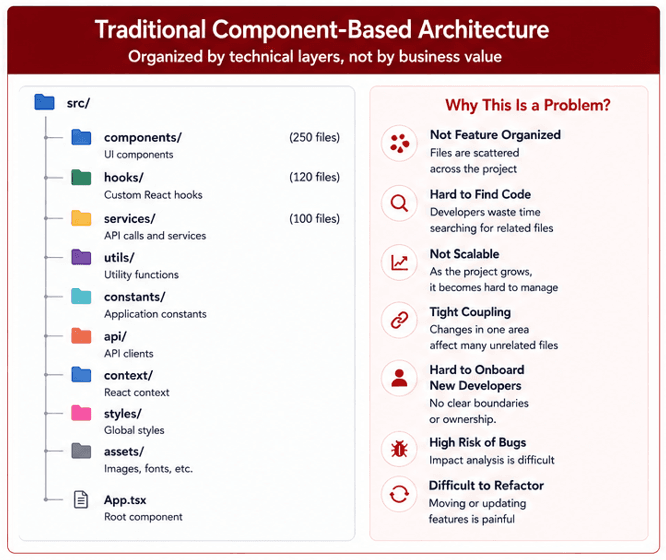
Traditional component-based architecture is organized by technical layers, not business value.
A Feature-First Way to Structure Your Application
The idea behind Screaming Architecture is simple: keep the files for a feature together, instead of splitting them by technical type. A typical feature-based folder structure has four core folders:
- App holds the core application setup: routing, providers, and global configuration
- Features hold each feature’s own components, APIs, hooks, and state
- Shared holds only the code genuinely used across more than one feature
- Pages hold the pages users actually navigate to, bringing together the features needed for each screen.

Screaming Architecture (Feature-First Approach) folder structure that screams what the application does

The four core folders explained: App, Features, Shared, and Pages
Real-World Example: Order Management in E-Commerce
Consider the order management module in an e-commerce application. In a feature-first structure, its components, API calls, hooks, types, and utilities all live together under a single OrderManagement folder. When a developer needs to change anything related to orders, there’s no guesswork about where to look.
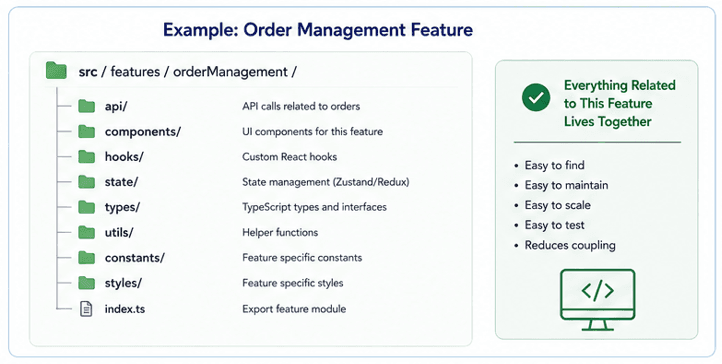
Example: The Order Management feature everything related to this feature lives together.
This won’t make a large application simple overnight, but it makes related code easy to find, keeps testing and refactoring focused, and gives the whole team visibility into which part of the codebase maps to which business feature.
Why This Matters for Growing Engineering Teams
- Less time spent searching for related files, more time spent building
- Clear ownership: it is easy to see which team or developer owns a feature
- Faster onboarding: new developers have an obvious starting point
- Safer refactoring changes stay scoped to the feature being touched
- Structure that continues to hold up as the codebase and team scale
This approach fits especially well for modular applications and micro-frontends, where different teams need to work independently without stepping on each other’s code.
How Triveni Applies This in Client Projects
At Triveni Global Software Services, we build applications designed to grow, not just launch. On projects ranging from early-stage MVPs to scaling SaaS platforms, a feature-first structure keeps codebases maintainable long after the first release, so our clients aren’t rebuilding their architecture every time they add a new team or feature.
If you’re planning a new product build or your current codebase has become hard to navigate as it’s scaled, our Product Engineering & MVP Development and SaaS Architecture & Platform Scaling teams can help you structure it right from the start or restructure it before it becomes a bottleneck.
Looking Ahead
As an application grows, folder structure stops being a cosmetic choice and starts directly affecting delivery speed. Screaming Architecture, paired with modular or micro-frontend patterns, keeps a codebase understandable without requiring anyone to open every folder to find their way around.
Conclusion
Screaming Architecture puts an application’s main features first, keeping related code together instead of splitting it across technical folders. Shared stays reserved for code genuinely used by more than one feature. The result: code that’s easier to find, easier to reason about, and easier to hand off benefits that become more valuable as the application and team grow.
Frequently Asked Questions (FAQs)
It organizes an application around its main business features instead of splitting components, services, hooks, and other files into separate technical folders.
The name comes from the idea that a project’s folder structure should communicate what the application does. You should understand its main features just by looking at the folders, without reading the whole codebase.
It means keeping all the files related to one feature together, rather than organizing by technical type.
The exact folders vary by project. This article uses App, Features, Shared, and Pages.
Only code used by multiple features. Code needed by just one feature stays with that feature.
Yes, the benefits simply become more noticeable as the project grows.
Not directly. Its goal is better code organization so developers can find, understand, and maintain code more easily.
Yes, it isn’t tied to any one frontend or backend stack.
Yes, keeping features separate makes it easier to manage modular, micro-frontend-style applications.
Being able to find and understand feature-related code without searching through the entire project.
Share on Social Media
Related Blogs
What are Promises in JavaScript?
Read More: What are Promises in JavaScript?
Node.js Development Services:The Smart Way to Build Scalable Applications
Read More: Node.js Development Services:The Smart Way to Build Scalable Applications
How to Start with Enterprise Mobile and IOT Strategy
Read More: How to Start with Enterprise Mobile and IOT Strategy
What is SqlDependency in .NET language?
Read More: What is SqlDependency in .NET language?Stay ahead of the curve
Get the latest insights, tutorials, and industry news delivered straight to your
inbox. Join 10,000+ developers and tech leaders.